Avoiding the Overcorrection: How to Lead Responsibly Through 2026’s Great Correction
Welcome to 2026!
Every January invites new predictions—marking a pivot point for leaders to decide what’s worth prioritizing in the new year.
2026 marks a year where the rapid rise of AI, tightening accessibility regulations, and growing public accountability are forcing organizations to confront long-standing inequities. These gaps can no longer be dismissed as “oversights” or “resource constraints.”
In my final post of 2025, I predicted that this year would bring The Great Correction: a necessary course-shift away from performative accessibility and toward ethical, community-led, data-driven inclusion.
Yet, as we enter this new era, we must be conscious of the risks that such a pivotal shift brings…
Why 2026 Must Be About Intent, Not Just Velocity
A correction without intention becomes an overcorrection. Even worse, an overcorrection risks creating new inequities in the name of solving old ones.
In the rush to respond to regulatory pressure or to “modernize” their systems, many organizations are tempted to bridge systemic gaps overnight. They may try to throw new AI-enabled tools, refreshed policies, and overpromises at the problem — all without shifting the underlying culture, accountability structures, or the actual lived experiences of employees and customers with disabilities.
2026 cannot be allowed to become a year of hurried, "plug-and-play" solutions. Instead, it must remain a year of responsible, intentional transformation.
When Overcorrection Backfires
Overcorrection often masquerades as progress—especially in large organizations eager to signal momentum. In my consulting work with 2axend, I’ve watched well-intentioned decisions look impressive on paper while quietly failing the teams they were meant to support.
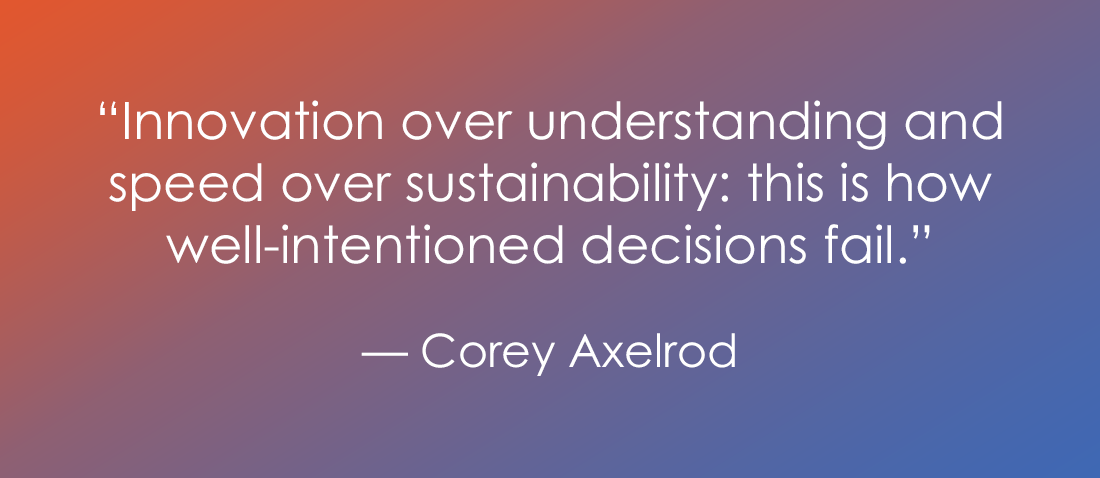
The common denominator is often the same: innovation over understanding, speed over sustainability, and optics over outcomes. We see this play out in four critical areas:
- Automation Without Oversight: Human expertise is replaced too quickly by "advanced" tools. AI-generated captions or speech-to-text systems are rolled out without human review. In medical, legal, or academic environments—where accuracy isn't optional—the result isn't innovation; it’s misinterpretation and exclusion.
- Tools Without Training: Organizations invest heavily in accessibility platforms but fail to invest in their people. Teams are flooded with new features, yet no one is trained to use them correctly or ethically. What was meant to create access instead creates confusion.
- Compliance Without Community: Companies rush to check boxes against WCAG or ADA requirements without meaningfully involving the Deaf, DeafBlind, hard of hearing, and disabled communities. The goal is safety, but the result is a solution that "technically" passes while practically missing the mark.
- Responsibility Without Authority: Disability-led E/BRGs are asked to fix systemic gaps and carry the emotional labor of education—without compensation or decision-making power. The mission is inclusion, but the outcome is burnout and stalled progress.
Overcorrection happens when organizations confuse speed with effectiveness.
2026 demands something different: intention, restraint, and leadership grounded in lived experience, rather than just rapid response.
The Path Forward: Intentional Correction
Merriam-Webster’s 2025 Word of the Year, slop, captured the flood of low-quality, unvetted output produced in the name of speed.
2025 exposed how quickly noise masquerades as progress. 2026 must be the year we ground ourselves in what works. This requires intentional, strategic correction—rooted in evidence, partnership, and cultural humility.
Successful organizations will resist the instinct to do more, focusing instead on doing better. Accessibility fails not from a lack of tools, but from solving the wrong problems.
Before adding another feature, leaders must ask: does this dismantle systemic barriers or merely ease immediate discomfort?
In accessibility, precision beats accumulation. One well-trained interpreter outperforms a stack of unvetted captioning tools. One trusted accommodation process outweighs five disconnected systems. One Deaf-led advisory group with authority creates more impact than a dozen powerless committees.
AI can support accessibility, but it cannot be the final authority. Humans ensure accuracy; Deaf communities ensure cultural alignment. Without a human-in-the-loop standard, organizations risk the ultimate overcorrection: trading effective access for cheap speed. AI is an asset only when guided by trained interpreters, CART professionals, and continuous user validation.
Sustainable accessibility cannot be built for the community; it must be built with them. The "Great Correction" requires that accessibility be Deaf-designed, informed, and approved. Deaf professionals must be embedded in AI governance, and BRGs must be treated as mandatory stakeholders, not optional advisors. Impact metrics should be shared transparently with the community, not hidden in executive dashboards.
When you build with the community, the guardrails are in place from the start.
2026 is the Year of Durable Change
2026 is about durability over disruption. The Great Correction is a long-overdue recalibration—one that requires evidence, accountability, and the humility to slow down so change actually holds.
By resisting overnight fixes in favor of community-led transformation, organizations can move accessibility from a temporary initiative to a foundational pillar of work.
Now is the moment to build accessibility proactively and intentionally. Move beyond temporary fixes; repair the systems at their core. When we do that, 2026 can be the year we get it right - because we finally took the time to do it right.
2axend is your partner in this journey. Through the 2axend Hub, industry-leading virtual events, to strategic advisory services, our Deaf accessibility experts ensure your correction is not temporary, but lasting.