
From Accommodations to Access Needs: Why Language Is the Missing Shield
For years, organizations have relied on policy as a shield.
Hefty legal documentation and organizational processes as a way to mitigate risk, demonstrate compliance, and protect themselves from legal exposure.
I’ve seen the effects of this mindset firsthand while auditing accessibility policies for healthcare and corporate clients. Often, these rigid procedures fail to account for the actual lived experiences of Deaf and hard of hearing stakeholders
This is because policies as a shield that were built on incomplete understanding doesn’t protect anyone for long, nor does it result in positive experiences for Deaf and hard of hearing individuals.
If 2026 is truly the year of The Great Correction, then moving beyond shield-building must be the goal. This moment is not about retrofitting fundamentally flawed systems to avoid liability, but about course-correcting the way access is understood, named, and designed in the workplace. It’s time for leaders to stop treating accessibility by playing defense, and start intentionally rebuilding language, policy, and practice around access needs as essential infrastructure.
Systems must protect people not after harm occurs, but before exclusion is ever possible.
The Importance of Access, Not Assistance
For Deaf and hard‑of‑hearing individuals, the fundamental need isn’t “extra help”—it’s communication access.
In the United States alone, nearly 48 million people live with some degree of deafness, representing roughly 1 in 5 individuals (Johns Hopkins; NIDCD). Yet participation and inclusion vary widely depending on whether a person’s preferred communication method is supported.
A person’s experience can shift dramatically based on how information is delivered.
For instance, providing signing Deaf and hard of hearing individuals with an interpreter is not a gesture of generosity or a special benefit; it is the removal of a systemic communication barrier that prevents full participation.
Conversely, many deaf and hard of hearing individuals, including those who have age-related hearing loss, do not use sign language. Whether they consider themselves disabled or not is irrelevant as they are also considered a protected class by federal law. Yet, despite “disability” protections in the US and other countries, many remain [culturally] uncomfortable or unaware that they can request accommodations.
Their barrier is often invisible: via listening effort. Many individuals navigate environments designed exclusively for "hearing-normative" communication, but struggle with the cognitive load required to piece together fragmented auditory input in rooms with poor acoustics, overlapping speech, inadequate captioning, or speakers who turn away. Since many can “pass” as hearing, their needs are often dismissed—until a breakdown occurs, a mistake is made, or trust is lost.
Policy rarely anticipates this group rooted in deep intersectionality, despite evidence showing they are the vast majority. These systemic barriers don’t fit neatly into traditional accommodation models, nor do these individuals always identify as having a disability. After all, we exist on a vast spectrum of lived experiences—many of which are invisible, misunderstood, and routinely underserved by narrow legal definitions of “disability.”
Collectively, without consistent communication access, signing and non-signing Deaf and hard of hearing individuals experience information deprivation. They may be physically present but are functionally excluded from nuance, decision-making, and critical details.
I can go on (and on!) about the implications of information deprivation–but let’s shift into action.
Evolving from Shield to Infrastructure
In order to address the needs of marginalized populations, we must rectify systemic flaws by evolving from shield to infrastructure.
Instead of asking “who qualifies” for a specific accommodation, we must shift policies and processes towards implementing universal access defaults by addressing physical, systemic and behavioral/attitudinal barriers.
By shifting to accessibility by design, organizations protect their collective intelligence. This way, there’s no insight lost to a noisy room or bad connection.
Moving from “Accommodations” to “Access Needs”
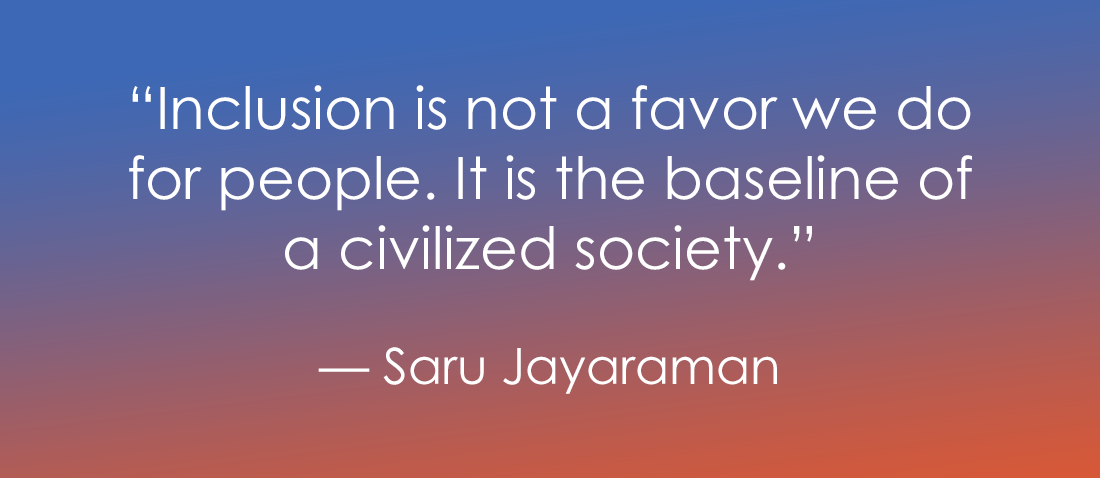
By its very definition, 'accommodation' places the labor on the person seeking it. It frames basic access as optional and exceptional, forcing the individual to justify their presence in a world that should have been built for them to begin with.
With this in mind, what if we stopped asking what accommodations people need and started asking them what their access needs are?
Don't let the simplicity of this mindset shift fool you. Moving away from 'accommodations' isn't just a wording change or about semantics. Shifting to using ‘access needs’dismantles the gatekeeping that makes accessibility feel like a series of exceptions. Using this phrase signals that participation does not require certain conditions, and reinforces the value that systems are responsible for meeting their stakeholders’ needs.
A Real-Life Scenario: Healthcare
For instance, consider the impact of this distinction in the healthcare space.
As I shared in a recent blog post about a recent surgical procedure, I was told that the length I could receive an interpreter was “capped by policy”. In reality, the hospital’s language services policy did allow continuous coverage through interpreter relief. The breakdown wasn’t refusal—it was fragmented understanding across departments.
When my access was framed as an accommodation, it appeared to the team as risky, extra, and outside the workflow. However, when it’s framed as an access need, it becomes a non-negotiable, fundamental component of care.
The Impact of Language Downstream
Before I wrap up, I’ll leave you with a key insight. Even the words organizations use influence the outcomes of every workflow possible. Shifting the burden of the access from the requestor to the system means ensuring accountability and positive experiences at every step of the way.
- Clinical coordination
- HR decision-making
- IT implementation
- Executive leadership buy-in
- Patient and employee trust
My point is, the language we use has a direct impact on lived experience:
Language shapes policy → Policy shapes workflows → workflows shape lived experience.
Looking Ahead: Access in Action
To move beyond good intentions, systems must be rooted in the linguistic and cultural insights of the Deaf and hard of hearing community. These perspectives address systemic gaps that policy frameworks often overlook, benefiting all stakeholders. Without this lived expertise, organizations risk solving problems they don't fully understand.
This is where our team enters the scene. 2axend guides organizations on their journey in moving beyond patchwork fixes toward durable, systemic change.
By centering lived Deaf and hard of hearing experience, our services help you embed accessibility directly into your policies, workflows, and culture. From strategic consulting to measurable training, we translate your intent into a resilient framework for lasting access. Our goal is to create environments where access is readily available and easy to navigate, shifting the labor away from the individual.
Hearing-led organizations naturally have perspective gaps; let us help you identify the systemic barriers you didn't know were there.
As The Great Correction continues in 2026 and long beyond, the fundamental shift from “accommodations” to “access needs” is essential.
It’s essential.
It’s meaningful.
And it changes everything.