For years, big-box retailers pitched self-checkout lanes as the ultimate corporate win-win: faster lines for consumers and lower labor costs for companies. Reality has been messier. Walmart is now scaling back self-checkout in some locations after discovering that replacing human cashiers with screens created operational bottlenecks, increased errors, and higher losses.
From the Grocery Aisle to the Exam Room
This shift offers a powerful analogy for healthcare systems substituting human proximity with Video Remote Interpreting (VRI), a real-time, on-demand interpreting service that connects two parties (who do not use the same language to communicate) with an off-site interpreter via secure video conferencing.
Like self-checkout, VRI is often promoted as a faster, lower-cost alternative to in-person interpreting, but it frequently breaks down at the point of care. Research led by Dr. Poorna Kushalnagar at Gallaudet University found that only 41% of Deaf and hard of hearing patients were satisfied with the quality of VRI services in healthcare settings. When video freezes, audio becomes unintelligible, or staff position the device poorly, critical visual information is lost.
I’ve experienced this firsthand. Several months ago, just before a cardiac-related procedure, VRI froze entirely during pre-op. When I later reported the issue, Language Services was unaware of the breakdown and had no real-time reporting pathway in place.
The result was not just a technical failure, but a breakdown in coordination between clinical staff, policy implementation, and language services that left no reliable mechanism to ensure continuous communication access.
The True Cost: Readmissions and HCAHPS
Healthcare systems should be careful about what they do and do not know. There is little empirical research directly measuring the impact of VRI on hospital readmission rates or HCAHPS scores for Deaf and hard of hearing patients.
Research involving patients with Limited English Proficiency has linked inadequate language support to roughly a 10% relative increase in 30-day hospital readmissions. While the populations differ, communication breakdowns create similar clinical risk.
Organizations may treat VRI as interchangeable with in-person interpreting despite limited evidence that outcomes are equivalent.
The Next Automation Test: AI
The same pattern is now emerging with AI-driven interpretation tools and sign-language avatars. These technologies are already being adopted into healthcare settings.
The real question is not whether healthcare organizations will adopt them, but whether they have the data to understand their downstream impact on Deaf and hard of hearing patients.
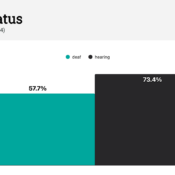
Most health systems do not routinely stratify patient experience, quality, or outcome data by disability status. As a result, they may be unable to identify whether communication barriers contribute to poor experiences, preventable readmissions, or adverse outcomes.
Walmart eventually discovered the hidden costs of replacing human expertise with automation. Unlike Walmart, healthcare organizations may never see the full cost of communication failures unless they intentionally measure and stratify outcomes for Deaf and hard of hearing patients.
At 2axend, we help healthcare organizations close that visibility gap by strengthening communication access evaluation, improving disability data stratification, and aligning innovation with measurable equity outcomes. Technology should support human expertise, not replace it.