
The Minimum Requirement Fallacy: Why We Must Demand Better
Have you ever stumbled upon a job description that made you do a double-take—and not for the right reasons?
Recently, I came across a social media posting for a sign language interpreter position in a specialized mental health setting that serves civil and forensic psychiatric inpatient consumers.
While the setting requires navigating some of the most complex linguistic and ethical territory in the interpreting profession, the stated minimum requirements in the job description were shockingly low.
Professional Standards vs. Minimum Qualifications
The posting, which requires only a high school diploma or its equivalent, represents a significant step backward for the profession. When we consider that the vast majority of qualified, certified interpreters hold at least a bachelor’s degree—and often specialized training for healthcare and mental/behavioral health settings—setting the bar this low is a failure to recognize the high-stakes nature of the work.
Furthermore, the requirement of only one year of experience in the fields of disabilities or behavioral health is simply not enough. We are talking about clinical diagnoses, legal rights, and patient safety; these are not settings for "minimum" effort or education. Even in many K-12 educational settings, which have their own systemic challenges, we often see more rigorous academic prerequisites than what is being applied to this high-risk environment.
This job description is a clear symptom of a larger issue: developing infrastructure without appropriate community or professional insight. When organizations draft these roles in a vacuum, they miss the nuance of what a qualified professional actually looks like.
Ultimately, relying on insufficient minimum qualifications ignores the specialized skill set required for these complex settings and ultimately undermines the safety and rights of those being served.
The Role Confusion: Distinguishing Interpretation from Education
The requisition also included a responsibility that should be a major red flag for any applicant: requiring the interpreter to provide staff instruction on American Sign Language, deafness, and Deaf culture.
This is a fundamental misunderstanding of the interpreter’s role. An interpreter is there to facilitate communication, not to serve as the institution's resident "expert" or educator. Education and training regarding Deaf Culture and ASL should be led by those with lived experience: Deaf professionals. Expecting an interpreter to fill this gap:
- Creates an ethical conflict: It blurs the lines of the interpreter's role within the clinical team.
- Displaces Deaf perspectives: It takes away opportunities for the community to lead their own education and fuel systemic change.
- Undervalues the expertise: It treats cultural competency as an "add-on" task rather than a specialized field of its own.
However, if there is training on working with interpreters, I recommend a collaborative approach led by both an interpreter and a Deaf individual. This ensures that questions are addressed by the person with the most appropriate lived experience and expertise.
The "Great Correction" Needed
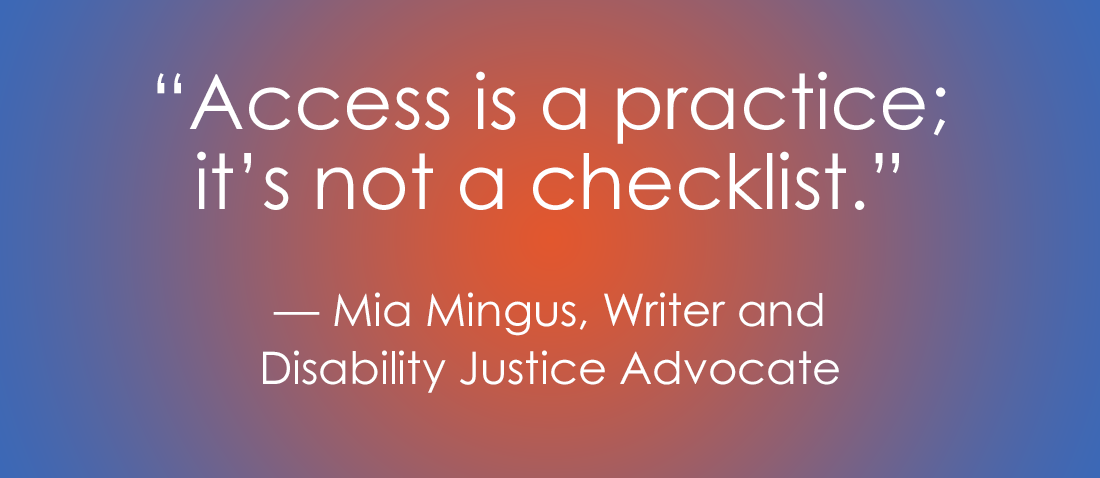
We often talk about the labor required by individuals to navigate these inaccessible, poorly designed systems. When an organization puts out a job description like this, they are essentially signaling that they view accessibility as a reactive checkbox rather than a proactive, inclusive infrastructure.
We need to move away from these "minimum" standards and toward a model where executive leadership takes ownership of accessibility. This means consulting with the community and qualified professionals before a job description is ever posted.
If we want to ensure high-quality outcomes in healthcare and mental health for individuals who are deaf and hard of hearing, it’s time to stop settling for the bare minimum. We need to develop systems designed with access as the default, not an afterthought.
2axend is uniquely positioned to serve as that bridge to the community, offering strategic consulting, professional training, and organizational audits to ensure your infrastructure is built on a foundation of equity and specialized expertise. Reach out to us today to begin the conversation on how to align your standards with professional excellence.
Recent Posts
Deaf Interpreters Belong in the Workplace Too

Stop Measuring Deaf Talent in English