
The Buffer System: Why Inclusion Needs an Institutional Shield
In the early stages of my career, I was fortunate to work under a Marketing Director, Dave Doran, and a Chief Marketing Officer, Ken Herron, who were committed to my success and fundamentally understood that the extra steps required for accessibility were not mine to carry alone.
When I was scheduled to attend a major external industry conference, the conference organizer pushed back on their legal responsibility to provide the required access. Dave and Ken didn’t ask me to argue my case, negotiate with the organizers, or prove my worth. They simply said, "If they refuse to hire interpreters, we will send our own to ensure you have the access you need."
In that moment, they weren't willing to just pay for a service, but rather act as a Systemic Shield. Both recognized that the burden of navigating institutional friction, especially when dealing with external vendors or conferences, should never fall on the shoulders of the individual. The two created a buffer, shielding me from the exhaustion of systemic advocacy so I could focus on the work I was hired to do.
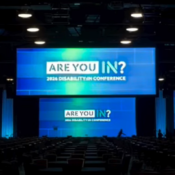
As I prepare to head to the Disability:IN Global Conference & Expo next week representing 2axend, I am reminded of how far corporate responsibility has come, and how much further we still need to go. It brings up a haunting question: What if that professional didn’t have such a great leader in their corner?
The Burden of the "Lone Advocate"
Across our workplaces, organizations have implicitly conditioned the Deaf and disability community to be their own lobbyists. Businesses expect employees to haggle with event planners, negotiate access needs with clients, and constantly out themselves just to gain entry to the spaces everyone else takes for granted. Companies have built environments that require a disabled professional to be an expert in bureaucracy and an expert in their own field simultaneously.
This is a failure of design. When an employee has to spend ten hours of their workweek emailing external conference organizers or vendor partners to ensure their session or meeting is accessible, companies are effectively gatekeeping talent. They are telling professionals that their inclusion is conditional and that their participation is a favor, not a right.
Moving Toward a "Buffer System"
Who should take this responsibility off the plate of the employee? It should be the entities that hold the power, the budgets, and the oversight: employers, leadership teams, and procurement offices. This is precisely the kind of systemic change and partnership we focus on at 2axend, helping organizations build frameworks where accessibility is baked into the foundation rather than treated as an afterthought.
Leadership teams and procurement offices must act as financial and operational buffers. A CMO, Director, or manager holds the keys to the budget. When organizations mandate that accessibility is a non-negotiable line item for every external contract, client meeting, or professional development request, they remove the friction from the employee. They turn the request into a standard.
The sphere of influence must also extend to sponsorships. When organizations sponsor events, writing a check isn't enough; they need to use that financial leverage to mandate full access as a non-negotiable term of their partnership. That means requiring organizers to treat accessibility as an upfront operational requirement, securing ASL interpreters, CART services, and accessible seating before registration opens, vetting venues and digital platforms, and baking compliance directly into sponsorship agreements so the burden never falls on attendees or speakers.
Redefining Leadership
True leadership is the act of removing barriers before the employee even realizes they exist. When Dave and Ken offered to provide our own interpreters for the conference, they were sending a clear signal to our team and the event planners that their employee belonged at the conference and their right to contribute would be protected.
If you are a leader, executive, or manager, ask yourself: Are you a buffer, or are you a bystander? When businesses leave employees to fend for themselves, they are essentially saying that their presence in the room is not a priority. But when companies build a shield around our workforce, institutionalizing accessibility so no one has to ask for it, they do not just help one person. They signal to the entire organization and their industry partners that they value excellence over bureaucracy.
As I pack my bags for next week's Disability:IN Conference, I am looking forward to having conversations with leaders who are committed to tackling physical, attitudinal, and systemic barriers head-on. If you are attending, let’s connect!
It is time to stop asking individuals to bear the tax of their own inclusion. It is time for organizations to step up and act as the shield, clearing the path so every professional can focus on contributing their brilliance to the world.
Recent Posts
Separate but Equal in the Movie Theatre