Deaf Interpreters Belong in the Workplace Too
All month, I’ve been writing about Deaf people and work.
Here’s an irony I can’t get past.
Some of the most skilled Deaf professionals in the country can’t find enough work.
Deaf interpreters.
A Deaf interpreter is a Deaf professional who teams with a hearing interpreter. They bring an innate ability to connect with other Deaf people, including those who have experienced language deprivation.
What the Data Says
The most complete national picture comes from a survey by the National Consortium of Interpreter Education Centers.
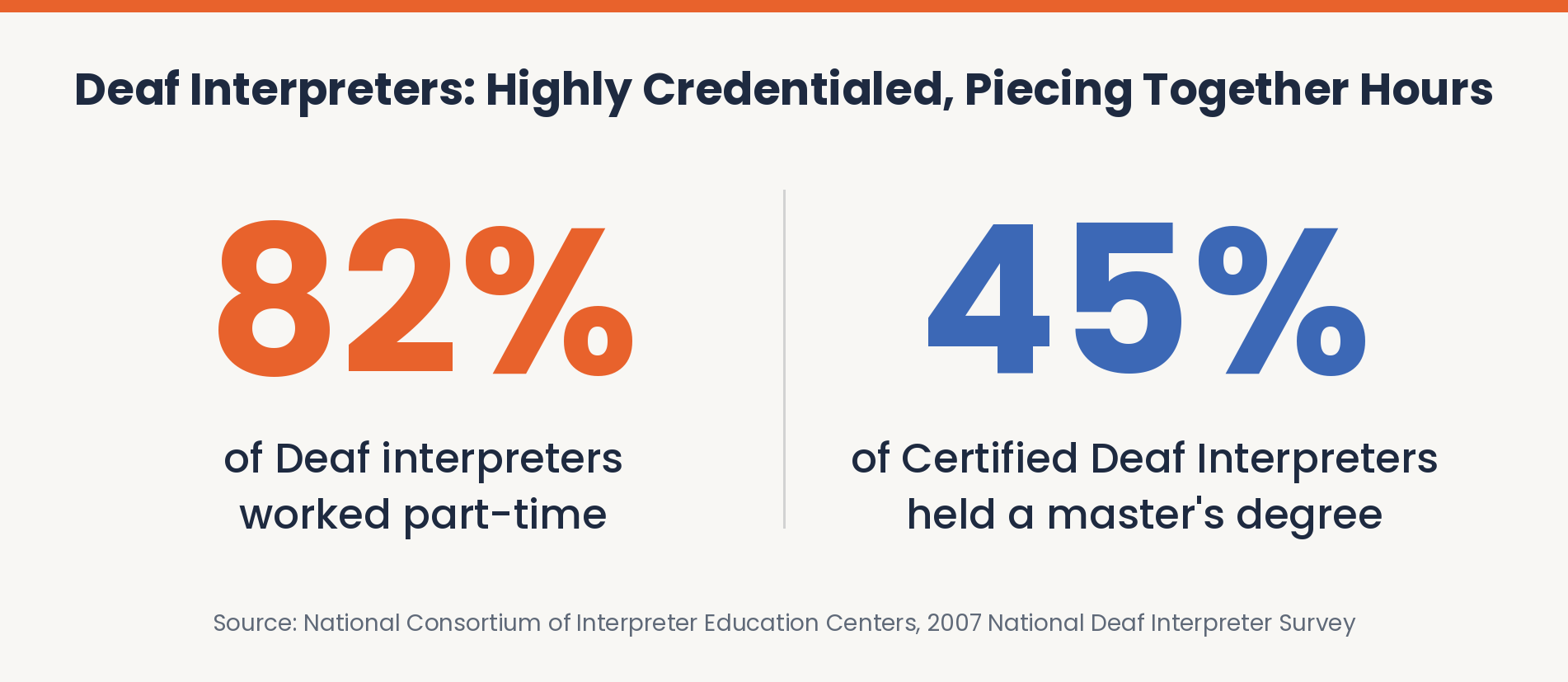
82% of Deaf interpreters worked part-time. 80% worked freelance.
These are not underqualified people. Among Certified Deaf Interpreters in that survey, 45% held a master’s degree.
Highly trained. Highly credentialed. Piecing together hours.
Two weeks ago, I wrote that gainful employment means full-time work for those who want it. Not hours pieced together.
That survey is from 2007. It’s still the best national data I can find. That tells you something too.
Today, the Registry of Interpreters for the Deaf reports a severe shortage of certified Deaf interpreters. The demand is there. The workplace hasn’t caught up.
Where We Picture Deaf Interpreters
When people think of a Deaf interpreter, they think of a hospital. A courtroom. A governor’s press conference. A conference stage.
Those are high-impact moments. A diagnosis. A verdict. An emergency announcement.
We bring in a Deaf interpreter because the message has to land.
The workplace rarely makes the list.
Why Not Work?
Last week, I wrote about language deprivation and how it follows people into their jobs.
Our systems failed many Deaf people long before they were hired. That doesn’t stop mattering at the office door. Or the plant gate.
Work has high-impact moments too.
The job interview. When the candidate and interpreter never quite connect, the hiring manager hears a weak answer. There’s rarely a second chance.
Onboarding. A new hire who signs without understanding hasn’t really agreed to anything.
Safety training. It’s fast, technical, and full of jargon. A missed detail can mean an injury.
An incident report. What the employee says becomes the official record. It has to be their account.
A performance review. Feedback only works if it lands. So does the employee’s side of the story.
An HR investigation. Whether the Deaf employee filed the complaint or is the subject of it, every word carries weight.
A termination meeting. A person deserves to understand why. And what comes next.
In a courtroom or an exam room, we’d ask whether a Deaf interpreter could help.
A person’s livelihood deserves the same question.
Who Benefits from a Deaf Interpreter
Not every Deaf employee needs a Deaf interpreter. Many don’t. For a routine meeting, a qualified hearing interpreter is often enough.
A Deaf interpreter can make a significant difference for a variety of Deaf employees, including those who have experienced language deprivation, use a sign language from another country, or are DeafBlind.
You may not be able to tell. That’s not your job. A qualified interpreter can. So can a good agency.
Who Decides
The Deaf employee. Not the hiring manager.
Many have never been offered a Deaf interpreter. They may not know it’s an option. So offer it. For interviews, ask when you schedule. Make it routine for high-impact meetings, so asking carries no stigma.
The hearing interpreter is your second source. They’re often the first to know when a message isn’t landing. If they recommend a Deaf teammate, that’s a professional judgment. Treat it like one.
What doesn’t count: How well someone speaks, lipreads, or writes English. Their degree. Their job title. Or a nod.
Not sure? Try it for one meeting. Then ask the employee and both interpreters how it went.
Providing an interpreter is not the same as providing communication.
An Investment, Not an Expense
Yes, two interpreters cost more than one. A misunderstanding can cost far more.
I’d ask employers to see it differently. This is an investment, not an expense.
Turnover is expensive. A dedicated employee is worth keeping.
A Deaf employee who is fully understood at work knows how rare that is. They know the next employer is unlikely to match it.
What Needs to Change
Employers: When a Deaf employee would benefit, ask for a Deaf and hearing interpreter team. Budget for it. Choose an agency connected to the Deaf community, one that can advise on language needs. Many can’t, and that’s a post for another day. Find one that can.
Agencies: Recommend a Deaf interpreter when it fits. Don’t wait for the employer or the Deaf employee to ask.
Hearing interpreters: Speak up when a Deaf teammate would serve the person better.
Two Wins
Every time an employer brings in a Deaf interpreter, two things happen.
A Deaf employee is fully understood.
And a Deaf professional gets paid for work they are uniquely skilled to do.
That’s gainful employment. On both sides of the conversation.
Want to know where a Deaf interpreter fits in your workplace? Schedule a meeting.

Recent Posts
Deaf Interpreters Belong in the Workplace Too

Stop Measuring Deaf Talent in English