Employed Is Not the Same as Gainfully Employed
On Tuesday, I helped Kraft Heinz kick off National Disability Employment Awareness Month.
I called my talk "Why Accessibility Matters: Moving Beyond Accommodations."
We looked at what meaningful access truly means, and why it requires functionally equivalent employment.
It comes down to critical moments. Interviews. Onboarding. Safety training. Performance reviews. After all, what happens in those moments impacts everything else.
Then we looked at what the numbers tell us, and at the role each of us has to play in changing them.
The Number
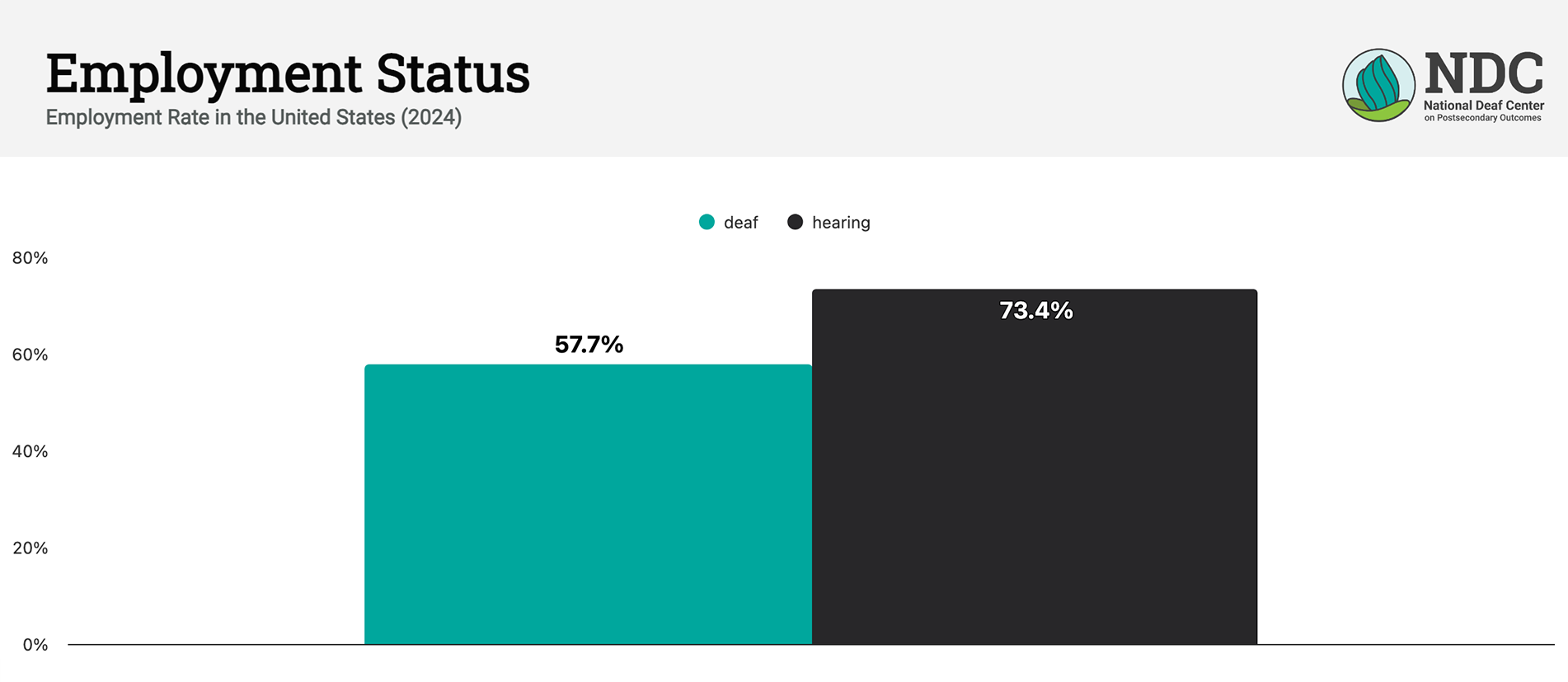
57.7%.
That's the share of Deaf and hard of hearing adults in the U.S. who have a job, according to the National Deaf Center. In fact, it's the highest rate on record.
It's up 8.3 points since 2015. That's real progress.
But hearing employment grew too. The gap is still more than fifteen points. It has not meaningfully narrowed in a decade.
A record high, but a gap that won't close. Both are true.
What the Rate Leaves Out
An employment rate asks one question. Do you have a job?
It doesn't ask if the job is full time.
Nor does it ask if the work matches your skills or your degree.
It also doesn't ask if you've ever earned a promotion, or if you can follow your own team meeting or shift huddle.
Here's the part every employer should sit with. Among full-time workers, Deaf and hearing people have the same median income: $60,000.
When we get full-time work, our pay keeps pace.
The talent is there. But the access to full-time, lasting work is not.
What Gainful Employment Really Means
We hear "gainful employment" a lot. Too often, it just means "has a job."
For Deaf and hard of hearing people, though, it has to mean more.
Full-time work, for those who want it. Not hours pieced together.
Work that matches our skills. New research from the National Deaf Center found a college degree doesn't pay off financially for Deaf graduates the way it does for hearing graduates. The researchers point to workplace communication barriers, fewer mentors, and limited paths to advancement.
Access to everything, not just the task. For example, the meeting, the training, the shift huddle, and the hallway conversation where decisions happen.
A path up. Promotions, stretch assignments, and leadership roles.
A job that doesn't come with a second job. No more booking your own interpreters, chasing captions, or explaining your access needs to every new manager.
One more number. 10.6% of Deaf adults with jobs work for themselves. Among hearing adults, it's 9.1%.
I'm part of that number.
Entrepreneurship should be a choice. For too many Deaf professionals, it's the exit.
Beyond the Corporate Office
Most accessibility conversations happen at headquarters.
But many of the jobs are somewhere else. Distribution centers. Factories. Warehouses.
That's often where access is thinnest.
Too often, the shift huddle happens out loud. Meanwhile, the safety alert is a sound and the training video has no captions. The interpreter comes for orientation, then never again.
As a result, a Deaf employee can work the line for years and never get a real shot at lead or supervisor.
Gainful employment has to hold up on the floor too, not just in the conference room.
Moving Beyond Accommodations
Accommodations get someone in the door. But they don't build a career.
An accommodation answers one person's request. Accessibility is how you design the workplace before anyone has to ask.
Start with the people most often left out. Then work your way in.
When you design for the margins, everyone benefits.
For example, captions began as access for Deaf people. Now hearing people use them every day.
Likewise, a visual safety alert installed for one Deaf employee helps everyone on a loud plant floor.
It's NDEAM. So every employer should be doing these things.
Measure more than hiring. Make access the default. Fund access centrally. Then ask your Deaf employees what's working.
Above all, don't silo it. This work can't live only within the Disability-related ERG or accessibility team. Instead, HR, legal and compliance, marketing, and research and development each have a different contribution to make.
A Job Is the Floor
This year's NDEAM theme is "Celebrating Value and Talent."
57.7% tells us who has a job. It doesn't tell us who has a career.
A job is the floor. A career is the goal. Each of us has a role in getting there.
Want to bring this conversation to your organization? Let's talk.
Recent Posts
Deaf Interpreters Belong in the Workplace Too

Stop Measuring Deaf Talent in English