
Reflections from AMPHL 2026: Moving Beyond the Advocacy Tax
It’s been several days since the close of the biennial Association of Medical Professionals with Hearing Losses (AMPHL) Conference, and I’m still processing the energy from such a powerful weekend.
Now that the dust has settled and we’ve all returned to our respective organizations, I’m struck by the lingering brilliance and resilience of this community. It was a privilege to facilitate an AMPHL social media takeover and engage with such a passionate and dedicated group of healthcare professionals.
It is 2026; we are no longer debating whether access is necessary. Now, we are analyzing why, in an era of unprecedented technological and systemic maturity, our healthcare institutions are still lagging behind.
The Expectation of Excellence, Not Exception
The prevailing sentiment at AMPHL 2026 was a collective demand for systems to catch up to the standards of modern medicine. We have reached a point where "workarounds" are no longer an acceptable or effective strategy.
In a high-stakes environment like a Code Blue or during critical surgical rounds, every second counts. As Dr. Chris Moreland noted during a session on protocols, Deaf and hard of hearing clinicians are often exceptional communicators precisely because they have been forced to navigate systemic, communication-related challenges. However, expecting those professionals to bridge the gap between inadequate infrastructure and the requirements of patient safety is a systemic failure of design.
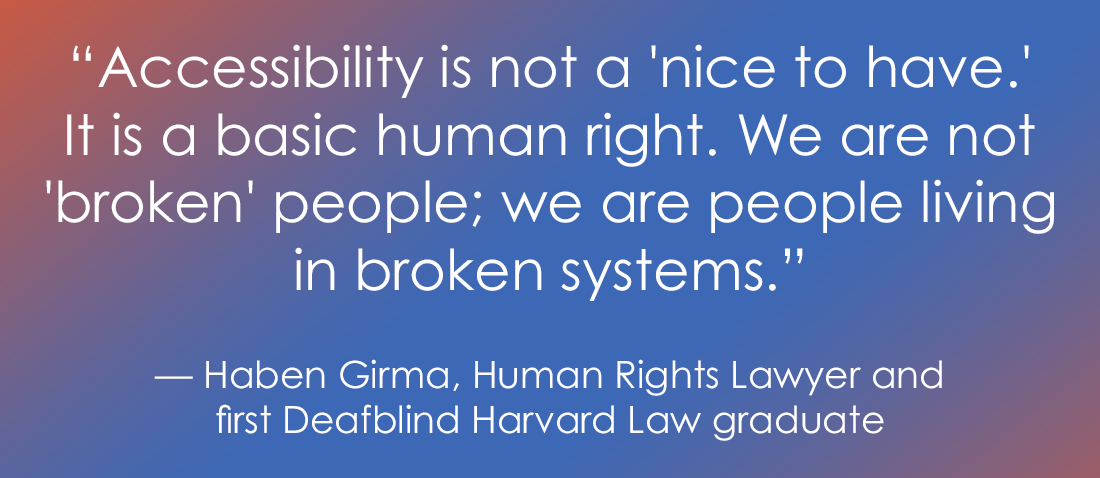
We are moving past the era where we should be explaining why access is vital. We are now in the era of demanding that access be an institutional baseline. In 2026, the question is no longer "How do we accommodate this individual?" but rather, "Why hasn’t this institution engineered a communication-resilient environment yet?"
Ending the Cycle of "Default Expertise"
Yet, the persistence of the 'advocacy tax' remains a significant barrier for the Deaf and hard of hearing community in particular. As Emily Mudrick shared during a session, “Deaf professionals are perpetually educating others.” Healthcare organizations must decouple clinical expertise from the burden of accessibility administration. This constant cycle of education is a direct result of professionals being forced to navigate environments not designed for them.
Similarly, Dr. Shazia Siddiqi highlighted the reality of the "Deaf tax" throughout the conference, underscoring how this invisible labor load detracts from the primary clinical roles of these providers. While lived experience provides unique insight, it is not a substitute for robust, institutionalized infrastructure. Healthcare systems must stop considering Deaf and hard of hearing clinicians as "accessibility consultants by default."
True organizational equity means:
- Decoupling Identity from Labor: Respecting that a Deaf or hard of hearing professional is there to provide healthcare—or perform their clinical duties—not to fix the hospital’s systemic communication gaps.
- Professionalizing Access: Accessibility is a technical and operational discipline. It requires dedicated, trained resources—not the improvised efforts of busy residents or attending physicians.
- Systemic Reliability: Just as a hospital wouldn't ask a clinician to fix the electrical grid to ensure the lights stay on during a procedure, they should not expect clinicians to engineer their own communication access.
The 2026 Standard: A "Visual-First" Reality
The 'Proximity Paradox' is real: being the most affected by a lack of access does not make the affected professionals the only ones responsible for fixing it. It is the responsibility of the institution to remove physical, attitudinal, and systemic barriers to ensure accessibility and inclusion for Deaf and hard of hearing professionals and allow them to focus on what they do best: saving lives and caring for patients. Reactive special treatment is not a solution. It’s time to implement standardized, reliable, and proactive systems that the tools of 2026 already provide.
If your healthcare organization is ready to shift into proactive accessibility, 2axend is here to help.
To everyone I connected with at the AMPHL Conference: thank you for your transparency, vulnerability, and your passion. Let’s take these insights back to our organizations and demand the shift from 'accommodating' to 'engineering.' It is time for access to be a fundamental, systemic right, not an individual hurdle.
Recent Posts
Separate but Equal in the Movie Theatre