
As a young player at the Stan Mikita Hockey School for the Deaf and Hard of Hearing, my experience was often filtered through an interpreter.
The coaches were mostly hearing and did not sign, relying on interpreters to communicate instruction during drills and games. I learned a tremendous amount, but there was often a layer between the players and the coaches. They understood hockey, but they didn't truly understand what it felt like to experience the game as a Deaf athlete.
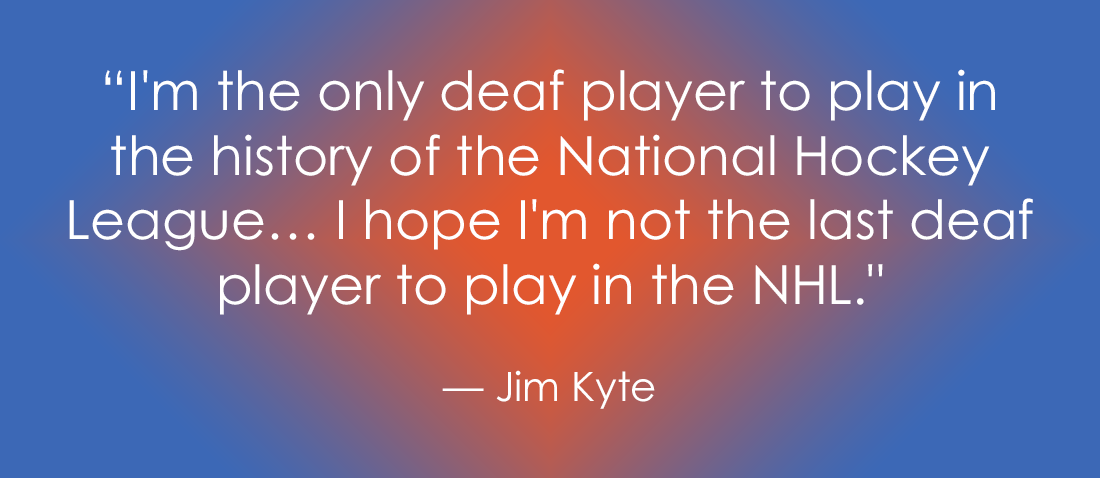
Yet, one of the highlights of those years was meeting Jim Kyte, the first legally deaf player to compete in the NHL. I have the 1992 Sports Illustrated article featuring Jim that I am pictured in hanging in my office.
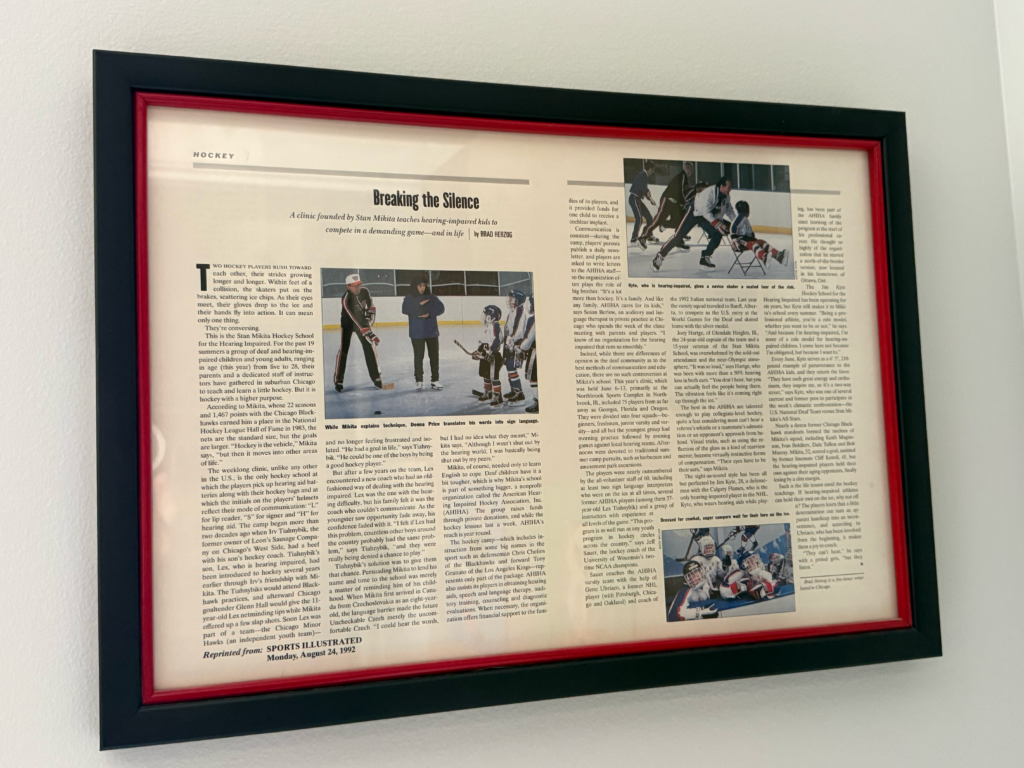
For many of us, Jim represented something we had not seen before: tangible proof that being Deaf or hard of hearing did not place a glass ceiling on our aspirations. He was not just a professional athlete. He was evidence that someone who shared our unique lived experience could navigate and excel at the highest level.
Returning as a Coach
More than 25 years after stepping off the ice for the last time as a camper, I returned to the same camp as a coach.
Since those earlier days, the shift is clear. More signing coaches are on the ice. More direct communication is happening between coaches and players. Young athletes are seeing adults who look like them, communicate like them, and understand their experiences without explanation.
The difference is immediate.
When coaches sign directly, the focus shifts. It is no longer about access or interpretation. It is about hockey. Pre-game instruction and practice huddles become connection instead of accommodation. Players are no longer defined as “Deaf athletes.” They are simply athletes.
For the first time, many of these players are learning from coaches who understand both hockey and what it means to experience the game as a Deaf or hard of hearing athlete.
Shared Experience Matters
Some of the most meaningful moments are the ones that seem small.
After an intense practice, I was drenched in sweat and had to remove my hearing aids. A player came over, and I motioned for him to wait while I dried them off.
To someone watching, it was routine. To us, it was shared understanding.
We didn't need to explain the frustration of moisture, the fragility of equipment, or the exhaustion of communication barriers. We both already knew.
Those moments matter. They build trust without explanation and remind young players that they are not alone in what they experience.
Seeing the Next Generation
This year, the campers met Noah Powell, a talented young player working toward becoming only the second Deaf athlete in NHL history.
Watching him on the ice, I thought about the chain of representation. Years ago, I looked up to Jim Kyte. Today, these players look up to Noah. Tomorrow, one of them may become that same example for someone else.
That is how representation works: one person breaks a barrier, another follows, and what once felt impossible becomes our new reality.
Modeling Possibility
This year, I also had the privilege of coaching my two sons alongside players ranging in age from four to twelve.
As I stood on the ice, I thought about what the kids see when they look toward the bench.
They see a coach.
But they also see something more: Deaf and hard of hearing adults leading, people who share their experiences, and proof that the barriers in front of them do not define what they can become.
During camp, I found myself thinking about my father and his work as a co-founder of Adult Role Models in Education of the Deaf, DeafBlind, and Hard of Hearing (ARMED). He believed that children need more than access. They need examples. They need to see people who share their lived experiences thriving as leaders, mentors, educators, and professionals.
Years ago, my generation found that example in Jim Kyte. Today, these players see it in Noah Powell and in the growing number of Deaf and hard of hearing adults leading in sport.
That is how progress happens: one generation opens a door. The next walks through it and holds it open for those who follow.
That is the lesson from camp.
Not just skating. Not just hockey.
But the power of seeing what is possible.