
Using Financial Leverage to Drive Accessibility
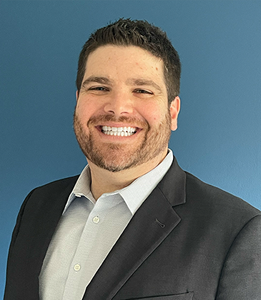
Earlier this week, Philip Endicott, a Deaf professional I’ve crossed paths with for more than twenty years, shared something many Deaf and hard of hearing people know all too well. I know it too. An organization decided built-in accessibility features were enough, and skipped providing ASL interpretation for an upcoming event. Philip's response cut right to it: "So you're making the decision for me?"
This isn't rare. It's the norm.
Accessibility isn't one-size-fits-all, and it's not an organization's call to decide what's "good enough." A feature is a means to an end, not the end itself. Calling something an accessibility feature doesn't mean it delivers access for everyone, and under the ADA, effective communication isn't a courtesy. It's a legal standard. Deaf people should decide what access looks like for them, whether that's ASL interpretation, captions, or something else.
At 2axend, we break inaccessibility down into three core dimensions: physical and technical barriers, attitudinal barriers, and systemic barriers. Philip's story touches all three.
Sponsors are positioned to address all of them by building expectations into the agreement itself. To this end, I wrote last month about how sponsors have financial leverage to influence change. Sponsorship is usually treated as a marketing line item. But that ignores a critical opportunity: the power to make accessibility a condition of doing business. Sponsorship dollars carry real weight. It's time companies used that weight to require access, not just fund a logo.
Organizers Respond to Incentives
When a company treats sponsorship as business as usual, event planners have little incentive to change.
However, when a major corporate partner makes accessibility a non-negotiable term of the contract, the dynamic changes. Access shouldn't depend on whether an attendee has the energy to request an accommodation, or whether an organizer decides built-in features are good enough. It should be built into the agreement before the first registration is submitted.
Accessibility Means Co-Designing, Not Just Providing
Accessibility isn't a checklist item. It's not enough to provide an interpreter, add captions, or install a ramp and call it done. During a conference I attended this summer, interpreters were provided for sessions, but nowhere to be found at the welcome reception or the closing party, the moments where most of the actual networking happens.
Access that stops at the main session isn't full access. It's a partial fix that assumes the job is finished once the obvious box is checked.
Real accessibility means co-designing the experience with the disability community from the start, not guessing at what they need and hoping it's close enough. That means communicating where interpreters will be positioned throughout the event, and providing a way to summon one if the need arises. It means accounting for meals and informal moments too. Organizers who skip this step aren't providing accessibility. They're providing the appearance of it.
Shifting the Responsibility
Financial leverage changes who is responsible for creating access. Right now, what should be baseline accessibility gets treated as an individual accommodation: something a person has to request, justify, and sometimes settle for less than what they need. That burden falls almost entirely on the individual attendee, speaker, or employee. A disabled professional registers for an event, discovers interpreters, CART services, or accessible seating were never arranged, and fights to get them added as an accommodation after the fact. That's a disability tax non-disabled peers never have to pay.
The current accommodation model:
The individual requests access → explains their need → waits for a response → negotiates for participation → sometimes receives access that isn't what they asked for or need.
The accessibility model we should be building:
The sponsor requires accessibility as a condition of the agreement → the organizer engages the disability community to define what that looks like → the organizer budgets for access → the event is planned around those requirements → attendees participate without having to request accommodations for full inclusion.
This is what happens when accessibility is left to an organizer's discretion instead of a sponsor's contract terms. Shift that responsibility to the contract, and organizers must treat accessibility as an upfront requirement, securing services and vetting venues before registration opens.
Scaling Inclusion Across Industries
Ultimately, this strategy scales inclusion across entire industries. It shifts responsibility from the lone advocate to the entities holding the power and the budget.
That's the difference between individual advocacy and institutional leverage. One person asking for access may change one event. A company making accessibility a condition of sponsorship can change how an entire event is designed.
Turning Leverage Into Action
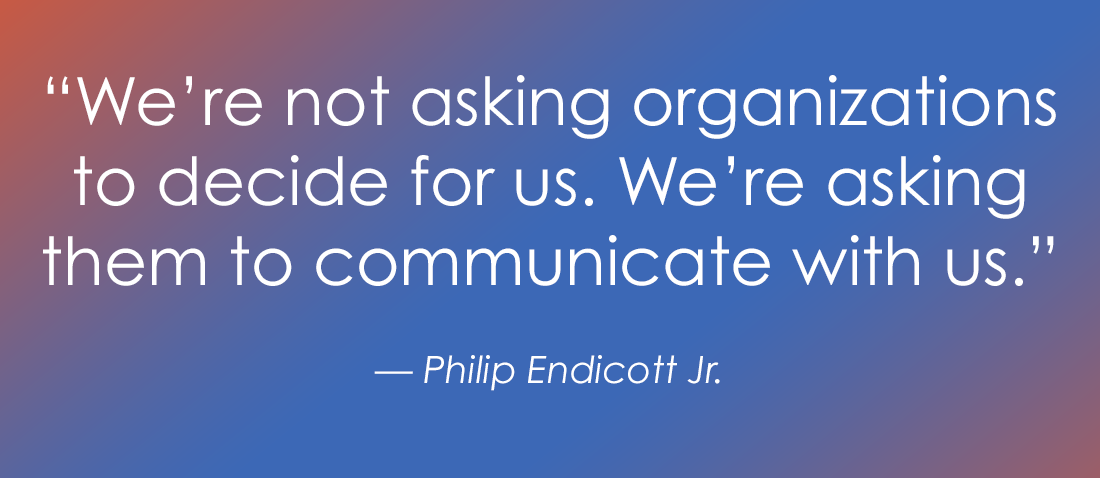
Philip put it best: "We're not asking organizations to decide for us. We're asking them to communicate with us."
If your company sponsors an event this year, ask one question before you sign. What does the accessibility line item say? If there isn't one, add it.
If you're planning an event, don't wait for a complaint to tell you what you missed. Build accessibility features into the budget before registration opens. And most importantly, ask Deaf attendees what they need. Don't decide for them.
If you've been the one fighting for interpreters or captions at every event you attend, you already know this fight shouldn't fall on you alone. Bring this to your accessibility and marketing leaders.
This isn't a big ask. It's a baseline. Use your leverage to make it one.
Recent Posts
Deaf Interpreters Belong in the Workplace Too

Stop Measuring Deaf Talent in English